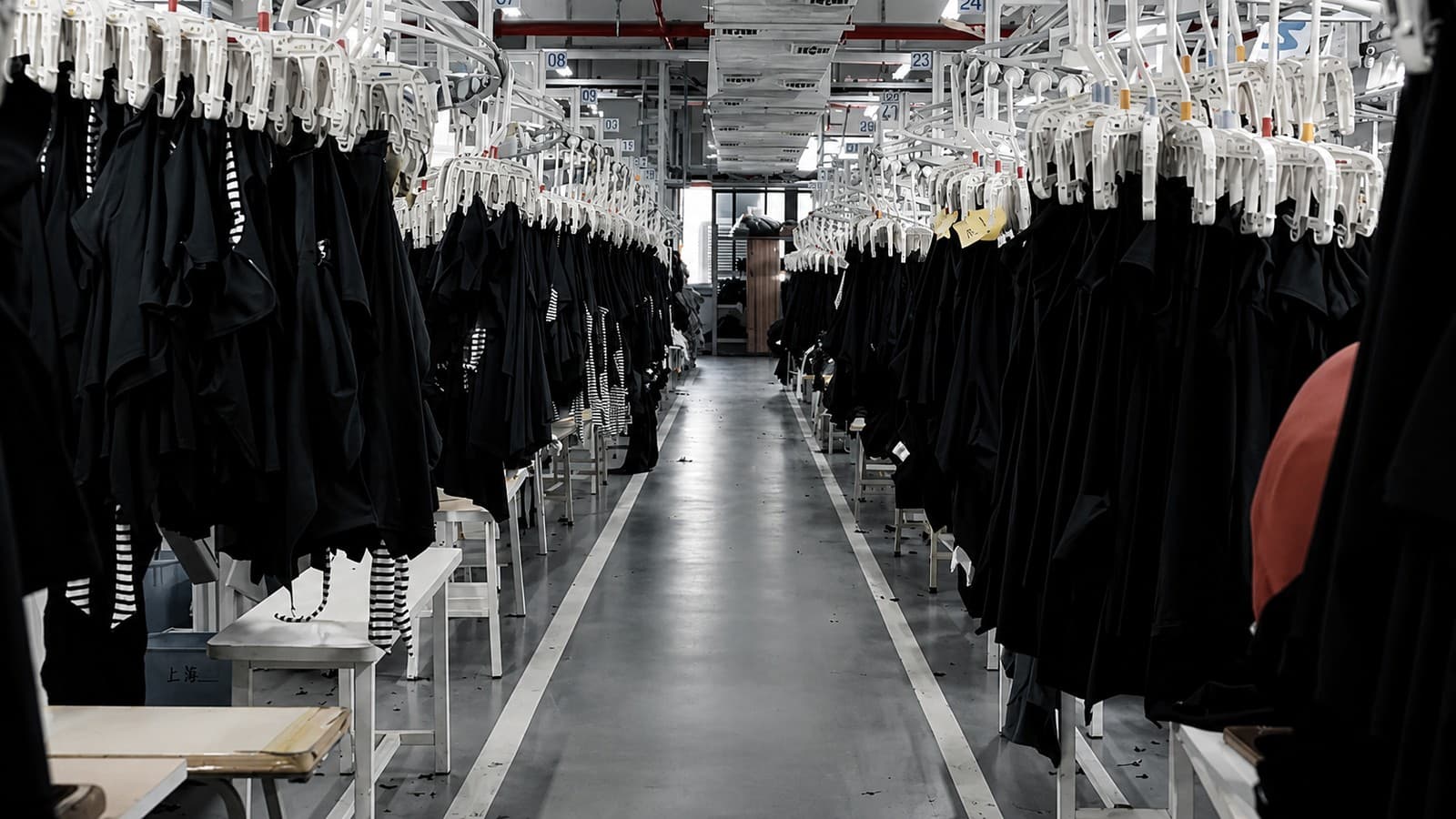
Most problems with a first order start before production, not during it. A brand picks a supplier based on a polished website, fails to verify who is actually behind the offer, and discovers the truth at the payment or delivery stage. This article is written from the factory side. TYX Manufacturing produces clothing under OEM and ODM models across eight factories in China and Cambodia, and we regularly see how brands approach a first contact.
Below are specific search channels, verification criteria and questions worth asking before you send a request for quotation.
Where to find clothing manufacturers in China
The main channels buyers use fall into three types: online platforms, trade fairs and referrals.
Online platforms. Alibaba.com, Made-in-China.com and 1688.com (China's domestic wholesale marketplace) are supplier databases with factory photos, certificates and reviews. The key thing to remember: the platform does not verify whether a company actually manufactures or simply resells. Alibaba.com has a Verified Supplier badge, which confirms that the company's registration documents have been checked — not that real production has been audited.
Trade fairs. The Canton Fair (Guangzhou) is China's largest trade exhibition, held twice a year — in spring and autumn. Both direct manufacturers and trading companies exhibit there. A face-to-face conversation with a manager at the booth and the chance to inspect samples in person gives far more information than email exchanges. TYX Manufacturing receives brand delegations at its factory in Dongguan during the Canton Fair — a factory visit is possible before any contract is signed.
Referrals. One of the most reliable approaches is to ask professional buyer communities, industry forums or sourcing agents who have hands-on experience with specific factories. A recommended factory has already been vetted by another brand.
How to tell a manufacturer from a trading company
A trading company (trader) resells: it takes your order and places it with a third-party factory. This is not always a problem, but you need to understand who you are dealing with — a trader does not control the production process directly, and any discussion of changes goes through an intermediary.
Signs of a trading company:
- address in an office building in a major city (Guangzhou, Shenzhen) rather than an industrial zone;
- a very broad product range spanning completely different categories (clothing, electronics, tableware) with no specialisation;
- evasive answers when asked "can we visit the production facility?";
- factory photos that turn out to be stock images or appear identically across multiple suppliers.
Signs of a direct manufacturer:
- a specific address in an industrial district (for example, Humen, Dongguan or Chigang);
- specialisation in specific clothing categories;
- willingness to accept audits and factory visits;
- an in-house pattern-making and tech pack development department.
The most direct check: ask for the factory's address and verify it on Google Maps or Baidu Maps — industrial buildings show up clearly on satellite view. Ask for the business licence listing the manufacturing address.
What to check before your first message
Even before you send a single enquiry, a few parameters are worth checking.
Production specialisation. Garment manufacturing is divided into specialisations: knitwear, woven garments, outerwear, sportswear, childrenswear. A factory that produces everything is more often than not making nothing itself. Ask which categories are the priority and what volumes they handle in those categories.
Minimum order quantity. Different factories calculate MOQ differently — per style, per colour, per total order. At TYX Manufacturing the minimum order is 200 units per colour. For more on how MOQ works and why figures vary between factories, see How MOQ Actually Works.
Lead times. Clarify two figures: sample lead time and bulk production lead time. At TYX Manufacturing these are 5–7 days for samples and 25–30 days for bulk production from the moment production launch is confirmed (not including shipping transit). Figures vary between factories; the key is to understand exactly what point a given manufacturer counts from. For a full breakdown, see Production Timeline: From Sample to Shipment.
Working format: OEM or ODM. If you have finished tech packs, you need an OEM manufacturer. If you only have an idea or a sketch, look for a factory with ODM development capability. Not every factory does both. See How to Choose an OEM Garment Manufacturer for a detailed look at what to look for in each case.
How to verify production capabilities
Verification is not only about documents — you also need to understand the real production process. Here is what to ask in the first round of conversations:
Production equipment. Ask to see what machinery the factory floor uses. Automated cutting, AGV robots for moving cut panels and ERP-based production management are signs of serious manufacturing, not just marketing copy. TYX Manufacturing uses automated cutting, AGV robots and intelligent warehousing at its Longyan and Chigang campuses.
In-house or subcontracted sewing. Some factories keep cutting in-house but outsource sewing to small workshops. This is not always a problem, but you need to know where your order will actually be made and how quality control is managed off-site.
Quality control. Ask whether the factory has its own testing laboratory or integrated testing centre. TYX Manufacturing carries out incoming fabric inspection, in-process checks and a final pre-shipment inspection by sampling. For a breakdown of each stage, see Quality Control at Every Stage.
References and portfolio. Ask for physical samples of garments the factory has produced for other clients. Seam quality, interlining, hardware and packaging are far more visible on physical samples than in photographs.
Certifications and audits
International certifications are one of the fastest ways to assess a factory's baseline level.
ISO 9001:2015 is a quality management system certificate. A factory with a current ISO 9001 has documented production and inspection procedures that are verified by an external auditor.
Sedex 4P (SMETA) is an audit of labour ethics: working hours, wages, working conditions and health and safety. It is increasingly required by international brands as a condition of working together.
GRS (Global Recycled Standard) applies to brands working with recycled materials. If you plan to launch a sustainable line, verify that the factory holds GRS certification.
TYX Manufacturing is certified to ISO 9001:2015, GRS and Sedex 4P. Ask to see the original certificates and check the expiry dates: most certificates are issued for three years with annual interim audits.
Important: certifications do not replace a personal audit or factory visit, especially for large orders. A certificate confirms the factory met requirements at the time of the audit; the real standard of production can only be assessed in person or through a third party.
Factory visit
A visit to the production facility is the most reliable method of verification. What to look for:
- order and cleanliness on the factory floor — chaotic production is usually obvious;
- number and activity of sewers — empty floors may indicate low utilisation or that real production happens elsewhere;
- presence of a pattern-making or development department;
- work in progress — ask to see what is currently being sewn; this shows the actual level of execution;
- fabric warehouse — maintaining an in-house fabric stock suggests the factory works with established suppliers and manages material procurement.
If a visit is not possible, commission an independent third-party audit (SGS, Bureau Veritas, Intertek, for example). The auditor will verify documents, production and the accuracy of stated capabilities.
Next step
TYX Manufacturing has worked directly with brands since 2007: eight factories in China and Cambodia, over 7 million units per month, shipping to 40+ countries. If you are looking for an OEM or ODM manufacturer for a new or transferred production run, send your brief through our enquiry form. We reply within 4 business hours and will confirm whether we are the right fit for your parameters.
Before submitting, it helps to have at least a preliminary tech pack or sketch ready — this allows us to give you an initial cost estimate from the start of the conversation. What a tech pack contains is explained in What Is a Tech Pack.