MOQ (Minimum Order Quantity) is one of the first numbers a brand hears from a factory, and one of the most misunderstood. Treated as a single fixed rule, it can rule out a factory that would actually work fine — or hide real flexibility a brand never asks about.
MOQ is set by the constraint, not by the factory's preference
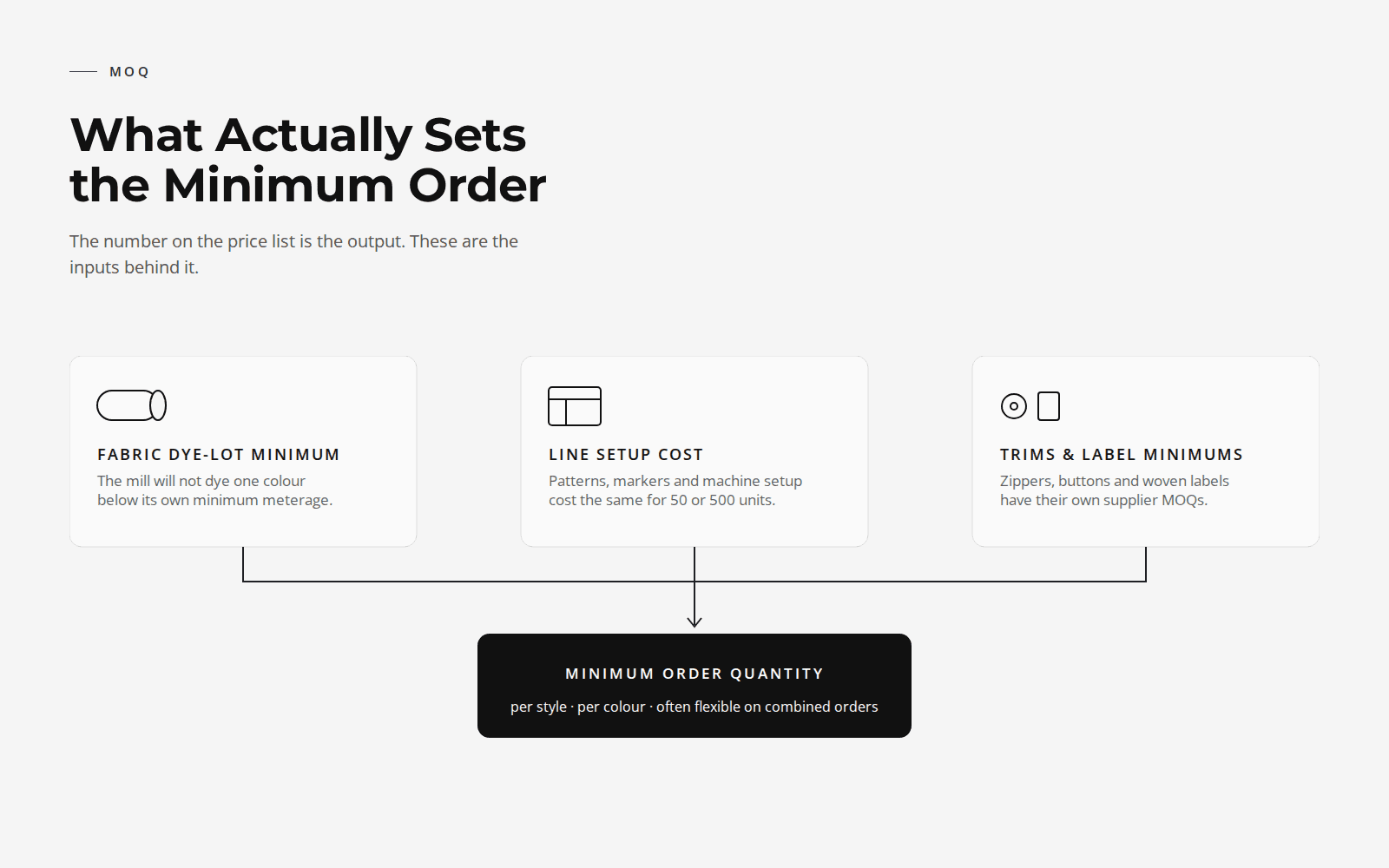
A minimum exists because certain costs don't shrink with order size — fabric is often woven or dyed in minimum production runs, a cutting layout only becomes efficient past a certain volume, and machine setup time costs the same whether 50 or 5,000 units are being made. The MOQ a factory quotes usually reflects whichever of these constraints is tightest for that specific product, not an arbitrary policy.
MOQ is per style, per color, or per order — and the difference matters
A factory that says "500 units MOQ" might mean 500 per color, or 500 total across several colors and styles combined into one production run. This single detail can change what a workable first order looks like, and it is worth asking explicitly rather than assuming.
Fabric MOQ is usually the real bottleneck
Garment MOQ and fabric MOQ are two different numbers, and fabric is usually the stricter one. A mill may require a minimum yardage per color per fabric type regardless of what the garment factory itself could technically produce below that. This is why switching to a fabric already in a factory's stock program can lower the effective MOQ more than negotiating with the garment factory directly.
Where MOQ actually flexes
MOQ tends to come down for repeat customers, for styles using fabric the factory already stocks, and for orders that combine multiple colorways of the same pattern. It rarely comes down simply by asking for a discount — the flexibility exists in the production structure, not in negotiation pressure.
The useful question is never just "what is your MOQ" — it is "what is driving that number for this specific product, and where is there room." A factory that can answer that clearly is usually one that understands its own production constraints, which is a good sign on its own.