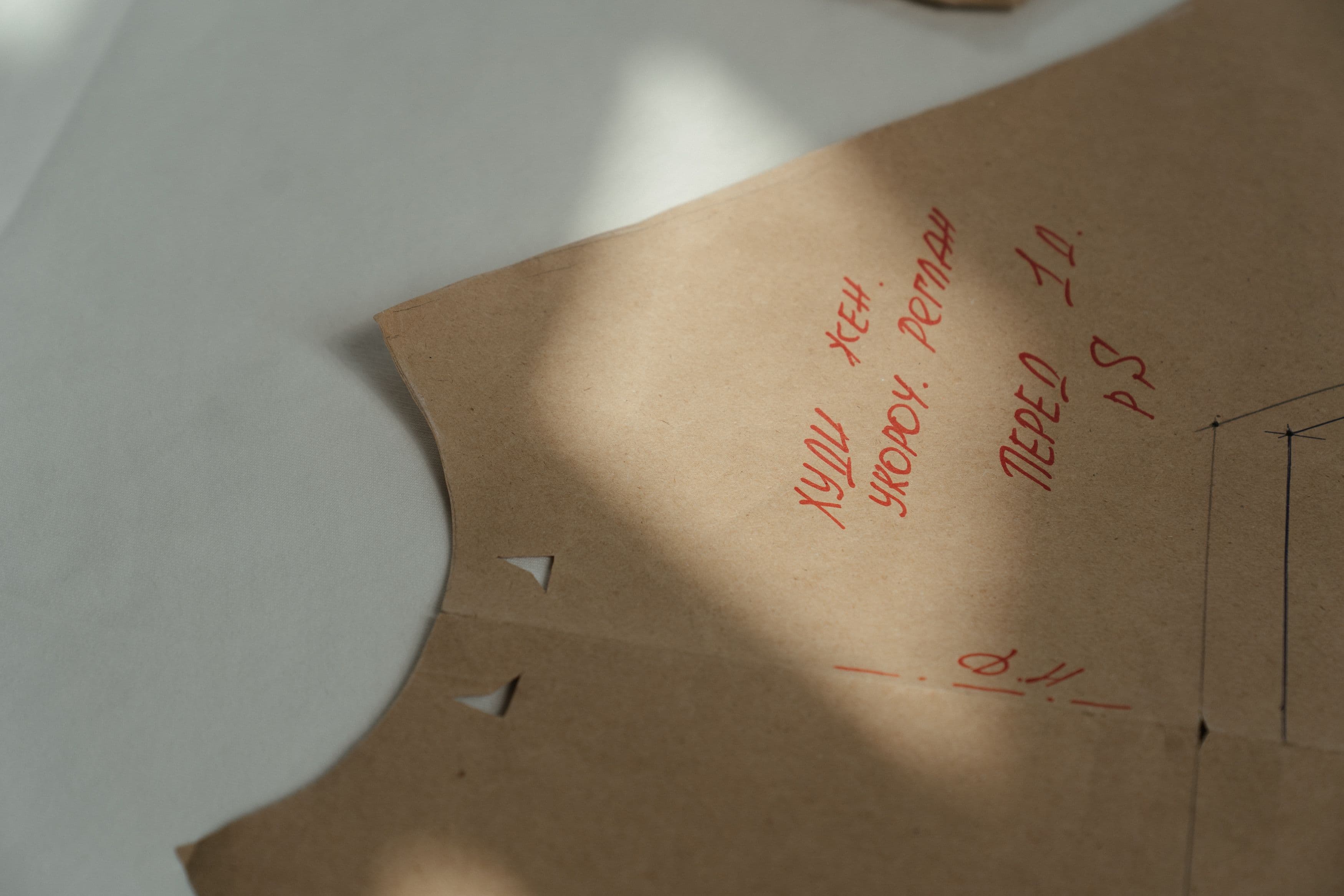
Say you have reached the stage where you need to produce a full size range, not just one sample. You already have a pattern for one size. The question is whether someone redraws the pattern from scratch for every size, or does it differently. Short answer: differently, and it is called grading. Here is what it actually is, how it works, and who does it in practice - the brand or the factory.
What pattern grading actually is
Grading is not making a new pattern. It is building a whole set of patterns for different sizes out of one base pattern, following fixed rules for increasing or decreasing each piece (wellconstruction.clothing, in Russian). In other words, you have a base-size pattern. Nobody redraws it from scratch for the next size - it is multiplied according to rules specific to that style and pattern-making method.
That is also why, on the production side, a factory only develops one full pattern set - for the base size. Every other size is produced through grading, not through re-development. It cuts the workload significantly, which is exactly why grading exists as its own step rather than a side effect of pattern development.
Why this matters
If every size were constructed from scratch, one style in eight sizes would mean eight independent pattern sets - and eight sources of small fit inconsistencies between neighbouring sizes. Grading solves both problems at once. It takes the base-size pattern, already proven on a sample, and carries its shape across the whole size range using one consistent set of rules. That keeps the sizes consistent with each other, because every one of them comes from the same proven pattern under the same rules.
How the process actually works
In the most common method - proportional-calculation grading - there are two key reference points: grading baselines and grading reference points. These are fixed construction landmarks (a horizontal and a vertical line on the pattern) that stay the same across all sizes, and every further shift is measured from them (wellconstruction.clothing, in Russian).
From there, pattern makers calculate grade increments - how far a given contour point shifts when moving to the next size up or down. The horizontal increments at the neckline, shoulder and side-seam points depend on two things: how much the relevant body measurement varies between sizes, and how far that point sits from the grading baselines. Points that sit right on a baseline move in one direction only; the rest move diagonally, combining the horizontal and vertical increments.
This is also why there is no single universal increment that works for every case - increments depend on the size subgroup. For example, in industry pattern-making practice, women's wear is split into subgroups such as 84-104, 108-120 and 124-136 cm, and the increment values differ inside each subgroup. This is an illustration of the principle, not a norm to copy - different pattern-making methods and different countries use different values.
The same logic shows up internationally. The industry commonly uses a 4 cm or 5 cm grade rule between sizes for bust, waist and hip - in some countries, the same values are historically expressed in inches, as 2″. Which exact figure applies depends on the region. What matters is not the number itself but applying it consistently across every cut on the same style (studiofaro.com).
Grading methods
Besides proportional-calculation grading, used in mass production, there are two other methods - radial grading and the grouping method. The grouping method is used for complex or non-standard constructions that do not yet have a developed grading scheme - in other words, where proportional-calculation grading is not yet applicable because there is no established method for that particular shape.
For standard ranges - t-shirts, hoodies, basic dresses, activewear - manufacturers almost always use proportional-calculation grading. It has established schemes for specific product types, and it is faster than the grouping method, which effectively requires keeping two pattern sets in mind at once to work out the increment values.
Who actually does the grading - the brand or the factory
In practice, this work is almost always done on the production side - the factory or its ODM team, not the brand itself. That is not because the brand "shouldn't" do it: grading requires a specific pattern-making method, increment schemes for that particular product group, and experience - otherwise the pattern drifts out of fit once it is multiplied. Keeping this in-house only makes sense if the brand already has a staff technical designer or pattern maker with that skill set.
If the brand doesn't have its own pattern maker, this is usually covered through ODM development. TYX Manufacturing describes its ODM development as design development, pattern engineering, sampling and full production support for brands building new collections (tyxmanufacturing.com/services). In other words, "pattern engineering" in that description is exactly building the base pattern plus grading it across the required size range - not a separate paid add-on.
What the brand needs to prepare
Even when the factory handles grading, the brand still needs to provide the starting material to grade from. It is usually part of the tech pack. That is also where grading rules are normally recorded - how each measurement should change across the size range, so the factory can produce the full stated range and not only the sample size.
At a minimum, prepare this before discussing the size range with a factory:
- An approved pattern or base-size measurements - what the factory will use as its starting point.
- A measurement chart with control points (bust, garment length, sleeve length and so on) for every size you need, not just the base size.
- The sizing system you work in - S-XXL, numeric sizes, or your own scheme - so nothing gets lost in translation to the production size range.
If you don't have a finished pattern or measurement chart yet, that's fine - that is exactly the gap that ODM development fills on the factory side. It is not a reason to delay the project until you hire your own pattern maker.
Common mistakes at this stage
One common mistake is sending the factory only a single-size sample, with no measurement chart for the other sizes, and expecting the factory to "figure out" how it should fit at other sizes. In that case, grading still happens - just by the factory's own defaults rather than your intent. The result may not match what you had in mind.
A second mistake is mixing sizing systems within one order - for example, sending a sample in one country's sizing and a measurement chart in international S-XXL without converting between them. This kind of mismatch usually surfaces at the fit-sample stage, when it is more expensive to fix than it would have been at the start.
Sources
- General characteristics of pattern grading - "Konstruiruem Odezhdu" (in Russian)
- Pattern grading by the proportional-calculation method - "Konstruiruem Odezhdu" (in Russian)
- Studio Faro - Grading Women's Patterns
If you already have a pattern or a reference sample and want to know what to sort out before grading it across a full size range, send it through our inquiry form - we respond within 4 business hours.