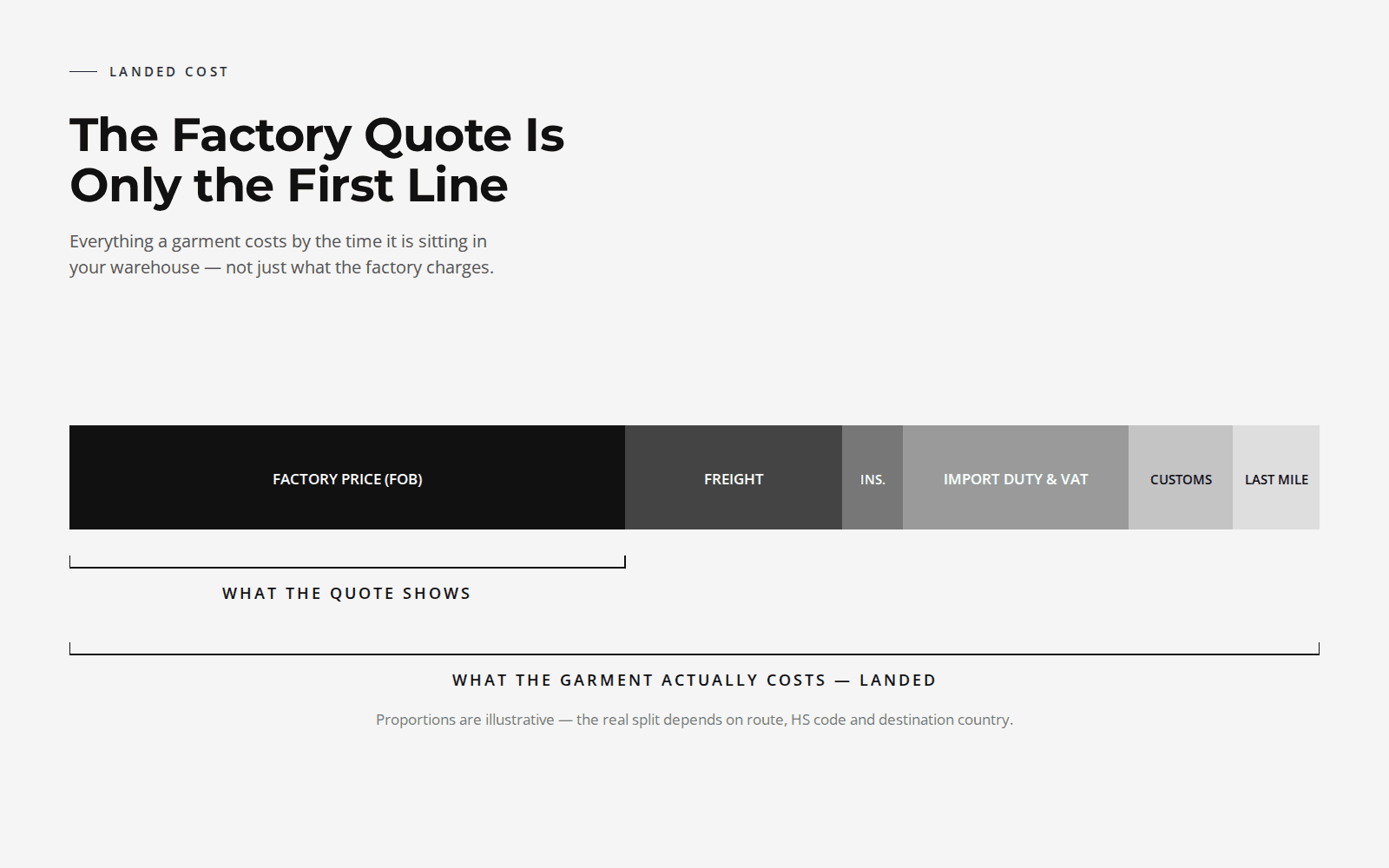
A common mistake for brands sourcing overseas for the first time is comparing suppliers purely on the FOB (Free on Board) unit price — the number the factory quotes. That figure is real, but it is not what a garment actually costs once it reaches your warehouse and is ready to sell. Landed cost is.
Start with the FOB price, but don't stop there
FOB price covers production and getting the goods loaded onto a vessel or aircraft at the origin port. Everything after that — the actual journey and its paperwork — is a separate set of costs that many first-time importers underestimate or forget entirely.
Freight and insurance
Ocean freight is usually quoted per container, not per unit, so the real per-unit cost depends heavily on how efficiently a container is packed. Air freight is faster but priced by weight or volume, and can silently erase a supplier's cost advantage on bulky items like outerwear. Cargo insurance is a small percentage of shipment value, but skipping it to save that percentage is a bet most brands regret exactly once.
Duties, tariffs, and customs clearance
Import duty depends on the product's HS (Harmonized System) classification and country of origin — the same garment can carry a different duty rate depending on where it was manufactured, which is exactly why country-of-origin questions matter during supplier selection. Customs brokerage fees and clearance charges are smaller line items, but they are recurring, not one-time.
Domestic costs after the port
Inland trucking from port to warehouse, any bonded warehouse fees, and the labor to receive, inspect, and put away inventory all belong in the same calculation. So does an allowance for defect rate — even a well-run production run typically has some percentage of units that won't make it to a sellable shelf.
A rough formula
Landed cost ≈ FOB unit price + freight and insurance per unit + duty and customs fees per unit + inland logistics per unit + a defect-rate allowance. Once brands run this full calculation instead of comparing FOB quotes side by side, the "cheapest" supplier on paper doesn't always stay cheapest in practice.