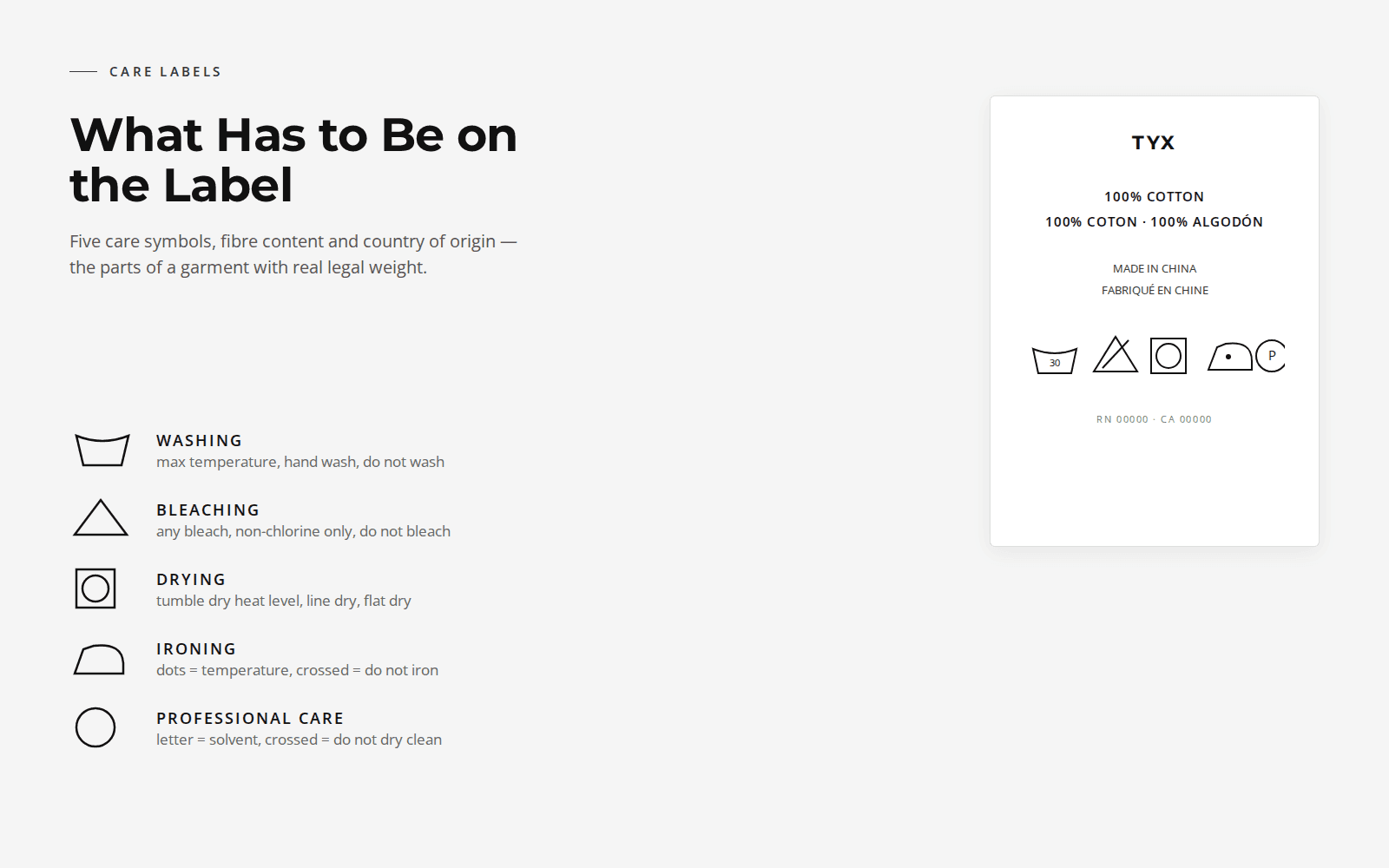
Most brands treat the care label as an afterthought — something the factory sorts out at the end. In practice, the label is one of the few pieces of a garment that has real legal weight, and getting it wrong is one of the more expensive mistakes to fix after a batch has already shipped.
What actually has to be on it
At minimum, a care label needs the fiber content by percentage, care instructions, country of origin, and often the manufacturer or importer's details, depending on the destination market. Requirements differ by region — the EU, US, and China each have their own rules about wording, symbol standards, and what counts as acceptable rounding on fiber percentages.
Reading the fiber composition line
Percentages on the label refer to fiber content by weight, not by feel or visual impression — a fabric can be labeled "80% cotton, 20% polyester" even if the polyester is what actually makes it stretch. Blends under 5% typically don't need to be listed individually in most jurisdictions, which is why labels sometimes look simpler than the fabric actually is.
Care symbols, decoded
The five core symbol families are washing (a tub), bleaching (a triangle), drying (a square), ironing (an iron), and professional cleaning (a circle). Dots inside a symbol usually indicate temperature or intensity — more dots means hotter or stronger. A single line under a symbol means a gentler cycle; an X through a symbol means don't do that at all.
Why labeling mistakes cost brands money later
Wrong care instructions lead to real returns — a garment washed exactly as the label says shouldn't shrink or bleed color, and if it does, that is a labeling failure, not a customer error, and most retailers will treat it as a refundable defect. In stricter markets, incorrect fiber content on the label can also trigger compliance issues that have nothing to do with the quality of the garment itself.
None of this needs to be complicated, but it does need to be checked deliberately — a good manufacturing partner treats labeling as part of quality control, not paperwork to handle after the fact.